Learning Forwards and Backwards1
“For if you believe, as I do, that all learning is but recollection, then it follows that learning is not a matter of getting new information but of remembering what the soul already knows.”
Plato
Theories on learning have been a productive field of human thought. I am entering this world to summarize my position on how learning operates and the different methods of learning.
Learning Forwards
Before making the argument of learning backward, I need to address the question of how people pick up base knowledge. These are the minimum facts you need before going further in conceptual depth. Ideas such as Newton’s Laws and many other “natural laws” would fall under the category. Initial learning begins with textbooks and readings and onwards until you have enough facts to create cognitive models.
Learning Backwards
After you have lived in the world and gathered a suite of “ontologies”, you can start learning by going backward. My idea of learning backward is adjacent to the concept of learning by “analogy”. Instead of learning something from scratch, you can take a preexisting structure and map it onto another domain.
For example, to teach someone how multithreading and async work, you wouldn’t start immediately on locking mechanisms or thread spawning. The sane approach would be to give a real-world analogy to motivate the development of those concepts, like cooking in a kitchen. It is more effective in learning information as the mental models are already there. They could then “work backwards” to understand the specific technical details.
In many high-information systems, learning backward would be the primary way of learning. However, if you know nothing about the specifics of the system or how they relate to each other, then it will be an incredibly inefficient way of learning.
Take the example of trying to understand a watch. I know the motors interact mechanically with each other within the watch to keep track of time. If I were to open a watch up, I would be lost because of how many intricate, fine-tuned decisions were made in putting together the watch2.
Citations
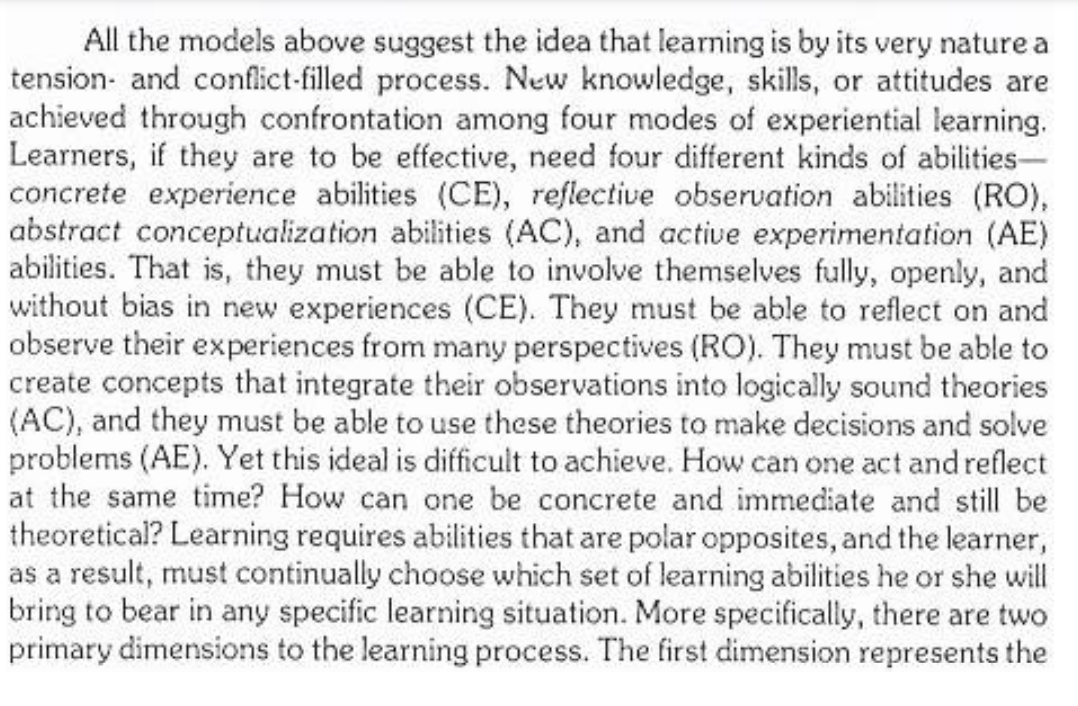
Kolb, David A. “Experiential Learning: Experience as the Source of Learning and Development. (1983).
-
(5/13/2025) I was getting at the same idea as Lakoff in “Metaphors We Live By” and our symbolic-semantic interpretations of the world. ↩
-
I found a paper to confirm my thoughts. Here is a screenshot of a section. ↩